
A fire system that works the day it's needed — and passes inspection the day it's checked.
Most fire systems fail on one of two days. The day the inspector arrives and the paperwork or the pump doesn’t match the code. Or the far worse day — when there’s actually a fire, and a detector was never zoned, a valve was left shut, or the pump won’t start.
We supply and install fire detection and protection systems that clear both. Designed to the code the authority actually enforces, installed to the standard the equipment was made for, and commissioned with a live test you witness — not a certificate handed over on trust.
What we supply and install
Eight fire systems, supplied and installed by one team — from a single detection panel to a full hydrant, sprinkler and pump-room installation.
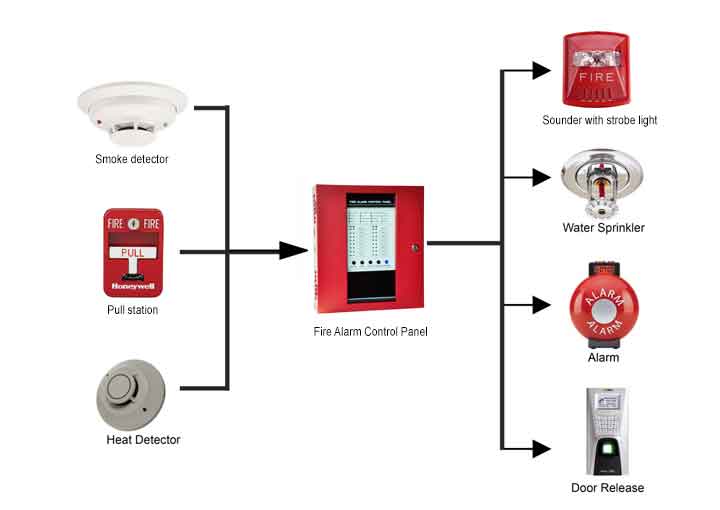
Fire detection & alarm
Addressable and conventional systems — smoke, heat and multi-sensor detectors, manual call points, control panels, zoning and cause-and-effect programming.
Fire hydrant systems
External and internal hydrants, landing valves, hose reels, riser mains and pipework to the required flow and pressure.
Automatic sprinkler systems
Wet, dry and pre-action sprinkler systems for factories, warehouses and high-hazard storage.
Fire pump rooms
Electric and diesel fire pumps, jockey pumps, controllers and pump-room pipework, commissioned to rated flow and pressure.
Gas & clean-agent suppression
Clean-agent (FM-200 / NOVEC / [equivalent]) and CO₂ systems for server rooms, electrical rooms and enclosed high-value areas.
Portable & wheeled extinguishers
Supply, placement and servicing of extinguishers matched to the fire class and the area they protect.
Public address & voice alarm
Evacuation PA and voice-alarm systems integrated with detection for phased, intelligible evacuation.
Emergency lighting & exit signage
Emergency luminaires and illuminated exit signage on the escape routes, sized to the layout.
What's included in the package
A fire installation from us is delivered as six things. If a supplier gives you only the equipment and a bill, the approval, the commissioning and the liability are left with you.
01 · Site survey & risk-based design
A survey of the actual building, an occupancy and hazard assessment, and a system designed to the real layout — zones, coverage, flow and pressure calculated, not copied from a standard sheet.
02 · Approval drawings & FSCD documentation
The drawing set and calculations in the form the Fire Service and Civil Defence and the building authority require for approval — prepared, submitted and followed through review.
03 · Supplied equipment, with data sheets
Detectors, panels, pumps, valves, pipework and suppression agent — each item supplied with its make, model and data sheet, so you know exactly what was installed, not just what was invoiced.
04 · Installation to standard
Pipework, cabling, mounting and containment installed to the equipment manufacturer's requirement and the governing code — pressure-tested and inspected before handover.
05 · Commissioning with a witnessed live test
Every device triggered, every zone verified, pump start and pressure demonstrated, cause-and-effect proven — with you present and a commissioning record signed off.
06 · As-installed documentation & O&M
As-built drawings, device schedules, test certificates, and operation and maintenance manuals — the file you hand an inspector, an insurer or the next contractor.
How we deliver it
- Survey before quote. We survey the building and assess the hazard before pricing. A fire quote produced from a floor area alone is a guess — and the gap between the guess and the real system appears as a variation halfway through installation.
- Designed to the enforced code, not a generic template. The system is designed to the code the authority actually reviews against and the occupancy class the building falls under — so it clears approval the first time rather than after two rounds of comments.
- Flow and coverage calculated, then proven. Hydraulic calculations for hydrant and sprinkler flow, detector spacing for full coverage, pump duty for the demand. Numbers first, then equipment sized to the numbers.
- Installed by the team that will commission it. The people who wire and pipe the system are the people who test it. Installation shortcuts surface at commissioning, so the team that has to prove it works is the team that builds it.
- Commissioned live, witnessed, and recorded. Nothing is signed off on a visual check. Detectors are triggered, valves are proven open, the pump is started against pressure, and the cause-and-effect matrix is demonstrated end to end.
- Handed over with a maintenance plan, not just a certificate. A fire system decays — batteries, seals, pump primers, blocked heads. We hand over the O&M file and a maintenance schedule so the system that passed on day one still works in year three.
Fire safety compliance in Bangladesh
A fire system in Bangladesh is judged against the authority, the building code, and — for export factories — the buyer. Four conditions shape almost every installation we carry out.

FSCD approval
Fire installations require review and approval by the Fire Service and Civil Defence [and the relevant building authority]. Designing to the code that will actually be enforced — and preparing the submission the way the authority expects it — is the difference between an approval and a re-submission.
BNBC fire provisions
Fire protection in Bangladesh is governed by [BNBC Part 4 — Fire Protection, EDITION], covering occupancy classification, means of escape, detection and suppression requirements. A system that meets the equipment spec but not the escape-and-occupancy provisions still fails.
RMG and export-factory standards
Garment and export factories carry additional obligations under [buyer and RSC / national initiative requirements]. For these buildings the fire system is tied to the factory's ability to keep operating and keep its buyers — not only to code compliance.
Retrofit into a running facility
Most Bangladeshi factories need fire systems installed into buildings that cannot stop production. Phasing the work, isolating live areas and testing without shutting the plant down is normal for us — and it is where an inexperienced installer causes either a production loss or an untested zone.
Standards and codes
Governing: [BNBC Part 4 — Fire Protection, EDITION] · Fire Service & Civil Defence (FSCD) requirements
Applied per system and client requirement:
NFPA 72 (detection & alarm) · NFPA 13 (sprinklers) · NFPA 14 (standpipe & hydrant) · NFPA 20 (fire pumps) · NFPA 2001 (clean-agent suppression) · [insurer / buyer / RSC standards]
Equipment: supplied to [UL / FM / EN / LPCB]-listed standards where the project or insurer requires it.
Brands we supply
[List the detection, panel, pump, valve and suppression brands you are an authorised dealer or supplier for — e.g. panels, pumps, sprinkler heads, clean-agent systems.]
Only list brands you can actually supply and, where applicable, are authorised for. “Authorised dealer / distributor” is a strong trust signal — and a checkable claim. An unsupported brand logo does more harm than an honest list.
Annual maintenance & inspection (AMC)
A distinct engagement, and the one that keeps a fire system alive. A fire system is not a one-time purchase — it is equipment that must be tested, serviced and kept ready. We provide annual maintenance contracts covering scheduled inspection, functional testing, servicing and priority call-out, with every visit documented for your insurer and the authority.
Common triggers
- A newly installed system that needs its first maintenance schedule in place
- An existing system inherited with a building, of unknown condition
- An insurer or buyer requiring evidence of regular fire-system testing
- A system that failed a fire inspection and needs bringing back into compliance
- Extinguishers or detectors past their service or replacement date
- A facility with no records of when the system was last tested
Typical programme
| Project | Survey & design | Approval | Supply, install & commission |
|---|---|---|---|
| Commercial building / office | [X] week | [X–X] weeks | [X–X] weeks |
| Warehouse / storage facility | [X] week | [X–X] weeks | [X–X] weeks |
| Garment / manufacturing factory | [X–X] weeks | [X–X] weeks | [X–X] weeks |
| Suppression for server / electrical room | [X] week | [X] week | [X] weeks |
Approval time depends on the authority and sits partly outside our control — which is why we start the FSCD submission early and in parallel, not after the design is fully closed. Equipment lead time on imported items can also govern the programme; we confirm stock and lead time at quotation.
Common questions
[State plainly: whether you prepare and submit the FSCD documentation, or prepare drawings for the client’s own submission. This is one of the first questions a factory buyer asks — a clear answer wins trust.]
Yes. We phase the work, isolate live areas and schedule the disruptive stages — pressure testing, tie-ins, the final live test — around your production. Tell us your shift pattern at survey and we build the programme around it.
[List your authorised and stocked brands for panels, detectors, pumps and suppression. Say which you are an authorised dealer for — it is a checkable, high-value claim.]
We do both. Most clients take a single-source supply-and-install package so one party owns the approval, the commissioning and the warranty. Where you have already procured equipment, we install and commission it — and tell you at survey if any of it won’t meet the code.
With a witnessed live test. Detectors are triggered, zones verified, valves proven, the pump started against pressure and the cause-and-effect demonstrated — with your team present and a signed commissioning record. We do not sign off a fire system on a visual inspection.
Yes, under an AMC or a one-off inspection. We start with a condition survey, report what is non-compliant or past service life, and then maintain it on schedule. See Annual maintenance above.
We survey the system against the inspector’s findings, give you a written scope of exactly what must be corrected and what it costs, and carry out the remedial work and re-testing. [Confirm whether you liaise with FSCD on re-inspection.]
[Priced by building type, area, hazard class and the systems required — detection alone versus a full hydrant-and-sprinkler installation differ greatly. State your quotation basis and, if you can, an indicative range. Buyers search for this and few competitors publish it.]
Book a fire safety survey of your building.
Send us the building type, floor area and what you need — a new installation, an upgrade, FSCD compliance, or maintenance of an existing system. We’ll survey the site, tell you what the code requires and what it costs, before you commit to anything.
[+880 XXXX XXXXXX] · [info@innovateengineering.com.bd]